After our initial production meetings, we have all agreed on the second idea; Embers. We believe this idea is more practical and is more effective because of its realism. Room 7 is an unlikely situation that doesn't often occur whereas murder is a, horrific, yet common thing to happen. We also felt that a location shoot would look much more effective than shooting on a fake set in a studio
Here is a simple synopsis of the title sequence:
Begin with a boy running through a forest, he is panicked and scared (just commit a murder) we see flashes of the murder combined with the shots of the boy running. He slows as the music reaches a climax, when we see a very quick shot of the boy swinging a log for the final hit on the victim. On the impact we cut to a mother sat at home, accompanied by a doorbell, the sound from the previous moments echoes out. She walks to the door, where the police tell her that her son has commit murder. We hear no sound just simply the intense music and sirens. In slow motion we see the woman break down before the title appears.
Today we were placed into random groups in which we will make our Thriller Opening Sequence. In my group is: Me, Grace, Bertie and Ksenia.
We had our first discussion, where we proposed each of our ideas and decided which ones were the strongest. We combined and developed them to produce two main ideas, which we felt could be effectively portrayed on screen to evoke tension in our audience. 'Embers' and 'Room 7' are the ideas we came up with:
Idea 1: Embers
Begin with slow motion flashes of someone screaming in a forest, flashes of fire and water. The person is clearly distraught. As the tension reaches its peak, fast cut to a close up of a mother, breathing heavily, accompanied by a doorbell, change to slow motion, music kicks in. Police at the door, without audio they tell this mother the bad news that her son has commit murder in slow motion to an epic song, she breaks down.
The whole film tells the story of a family that was once very rich but has now broken apart. After being provoked by a bully the main character a boy of 15 takes out his family problems on the bully and kills him accidentally. The Father who works as a detective, investigates the crime without knowing his son is the criminal. The mum discovers what the boy has done without telling her husband. Arguments begin to start in the family as the Father knows that they are hiding something. The father begins to have an affair, whilst the Mother and son try their best to destroy every bit of evidence the father finds which could lead him to discover who the murderer is. After a huge family argument, the Mother, who is drunk, engages in a physical fight, when she discovers that he has had an affair. He ends up hitting his wife as she goes crazy, and the son screams at his dad before he makes the revelation the his son is the murderer. He has the choice to either protect his son, or put him in prison. He decides to turn in his police badge before leaving the town and not reporting the crime.
Idea 2: Room 7
Opens with a man waking up in a room, it is cold and bleak, He is dazed and confused, lots of intense close up, with slow movement of his head, after a few seconds he properly wakes up, he is out of breath and scared. He realises he is in danger. He stands up and walks over to the wall, where there are scratching saying things such as “Help Me!”…. “Your going to die in here”… He looks at his distorted reflection in a smashed mirror. There is also a table with scalpels and surgical equipment on. We see the mans fear. He slowly walks towards it, there is a key hole, he bends down to look through the keyhole, pause for a few seconds, suddenly an eye appears through the key hole, shot of the door which says “Room 7”
The film is about a testing facility which is secretly funded by the government. In order to understand certain things about humans, testing which includes torture is necessary. A 17 year old boy is kidnapped and brought to the lab. Although speaking to the subjects is banned, a cleaner at the facility makes contact with the boy. The cleaner helps to free the boy, so they can expose the truth to the public, and get the place shut down.
Opens with a man tied to a chair in a room, room is cold and bleak, similar to a mental hospital cell. He is dazed and confused, lots of intense close up, with slow movement of his head, Suddenly fast cut to him in same position yet this time he is screaming and moving his head, blurring on his face, cut back to normal dazed and confused, this happens a few times before he properly wakes up fast, heart beat noise can be heard, he is out of breath an scared. He realises he is in danger and tied to a chair. He manages to wiggle a zippo lighter out of his pocket which he uses to burn the rope, and untie himself. He stands up and walks over to the wall, where there are scratching saying things such as “Help Me!”…. “Your going to die in here”… and religious cross symbols. He then sees a door, he slowly walks towards it, there is a key hole, he bends down to look through the keyhole, pause for a few seconds, suddenly an eye appears through the key hole, hot of the door which says “Room 45”.
The entire film is about a Man who she he reaches 18, is expected to take over the family buisness. He believes this is a psychological testing lab. He soon finds out that this is not the case. The business is an underground extreme testing lab, which consists of a series of rooms going all the way up to room 50. People are selected to be brought into the rooms where they are tested to their limits and challenge in a series of ways, every case is different. Some victims put through challenges to see how they cope under certain circumstances, others are tested on their mental stability, and some are tortured. All however, of those who enter the rooms, come out either dead or mentally unstable. The boy next in line to become leader of the rooms sees the immorality in the business and works together with a victim in room 45 to shut down the rooms, and stop this forever. Most of the scenes are conversations involving flashbacks between Victim 45 and the boy next in line, they each tell each other their stories, and see the gruesome mistreatment occurring through out the rooms.
Urban location. One teenager starts a fight on innocent teenager. He fights back and they get into a big fight in a backstreet or on small bridge. The innocent boy defending himself either badly injures or kills the other boy, by either, pushing him over a wall into a river, or pushing him back onto a spike, or rock onto his head, The boy is terrified, and panics and runs away, side shot of him running, the camera slowly drops back, and on screen we see the title “Confess”.
Film about a boy who spends four years covering up his accidental crime. After putting the wrong person in jail, four years later, the case is brought back up. he confesses and gets put into jail. The wrongly convicted man takes vengeance upon his family, and the boy plans escape to save his family from what he is going to do.
Begins with black screen, only hear a conversation between two people, discussing a document of great importance. Ink dropping on the page. We see extreme close ups on writing, like in the opening sequence seven. Then suddenly this fades the music stops, there is a pause. Suddenly we see a shot of a man bursting open a door, in the woods, he is chasing after a man holding the document. Chase sequence through urban streets, lots of close up and handheld, Begin to intercut with extreme close up from sparks of a lighter, tension rising and rising, when finally the man reaches a corner where he looks down and sees the document on the floor slowly burning away. Extreme close up on the document, it burns away the screen to reveal the title. Embers.
British Gang warfare. Failing gang that used to be very powerful, but there are only a few members left. The document that could have saved their gang is gone and burned. They must now try to save their gang and prevent attacks from opposing gangs.
Bleak day with rain, man digging a grave, slow, big tension,bit of dialogue, “keep digging”.
Guy comes running through the woods, sees whats going on. the guy points the gun at the new runner, the man digging suddenly turns, swings, hits him in the face with his shovel.
Cuts to title “undertaking”
Whole film about a man who owes money to an important group of people. He Is in a dangerous situation at the beginning, which goes in his favour as he avoids death. He struggles to find the money so he plans a robbery.
This sequence follows a man wearing a hoodie, through a council flat. The man is clearly determined as he walks up a flights of stairs, carrying a baseball bat, carelessly dragging it along behind him. When he reaches a specific house, he rings the doorbell and waits. As the door is opened he swings the bat and on impact the shot cuts to the title 'Turf'.
From the opening sequence I imagine the film to be set in an urban estate dealing with the rivalry between gangs over their neighborhood and how they assertauthority. The man has either been order to do what he does, or is out for revenge. This title sequence suggests lots of violence and conflict between criminals in a low income estate.
I believe the casting was very appropriate, the man appeared old enough to commit such a violent act, yet young enough to be in the crime, gang scene. he looked around 25, made to look slightly younger by the costume with a hoodie. It was believable that this man would be in this situation. His body language and expression conveyed the violence and sense that this man means business and you wouldn't mess with him.
This man is a very mysterious and shady character, he creates lots of enigma, thus drawing us in. As there is no dialogue throughout the sequence just simply ambient diegetic sound of sirens, the baseball bat, and his footsteps. There is no dialogue to reveal anything about this character. We merely base our judgement on his costume, his gesture, and his actions. We can tell this man is violent, and determined. He shows no hesitation whatsoever when making his way to the flat of his victim. This is clearly a regular occurrence in his world and he has little fear, because of it.
The sequence consists mostly of static tripod shots, of the actor, occasionally cutting away to close ups on spider webs, windows and walls in the council estate, illustrating the lower class urban setting. these static shots are very affective in building tension. In my opinion the occasional pan shots featured that track with the hooded character as he turns a corner almost break this tension. cutting from static to moving shots doesn't always work in a sequence such as this. I believe it breaks the realism of the scene, and reminds us that there is someone operating the camera. I find the go pro shot from inside the bag interesting. It is simply a creative POV shot, that adds another dimension to the scene. The handheld movement conveys an unstable atmosphere, and things are about to turn bad. This is also true for the close up handheld shot at the end of the sequence. We know there is impending danger from the instability and shakiness of the camera.
This sequence features no music, which I believe is an effective decision. It is very real, as we only here the diegetic sound in the scene. The sound of sirens reinforces the bad neighborhood setting, and further builds tension as the sound increases in volume through out the sequence.
Saul Bass was a renowned Graphic designer known for his work on title sequences, film posters and corporate logo's. His work was extremely influential, his inovative ideas and unique perspective of the world engaged his audiences and practically changed the Graphic Design industry. He has worked with some of Hollywoods most prominent film makers including Alfred Hitchcock and Martin Scorsese. among his most famous works are the title sequences from the films 'The Man With The Golden Arm' 'North by 'Northwest', Vertigo and the most famous film 'Phsyco'.
He is also responsible many famous logo such as Quaker oats, Kleenex, Continental Airlines and Dixie. I think the success of his Graphic design in Logos is successful because of its simplicity.
His work has a slight cartoon like style, which i find very interesting, it is similar to the work by Kyle cooper in 'Kiss Kiss Bang Bang
During this session we managed to finish editing our prelim. I worked with Crerer and Victor to create the final cut of the prelim. We continued to drag the clips into the timeline, cross cutting between the medium shots and the close ups of each character to form a sequence that flowed without the viewer noticing the cuts. The main problems we faced were associated with the sound. On some clips, the audio from one character overlapped, leaving us with an unclear repeat of the same line. In order to solve this we had to cut the sound from the first clip early, and replace this with background noise, leaving only the line from the second clip.
When the sequence was cut together we decided to give our prelim a more professional look. We did this by cropping the screen at the top and bottom to make a more cinema like ratio, also known as adding letterbox. We then added a fade at both the beginning and the end, so the sequence opened and closed softly instead of a harsh opening cut. Finally we added the text with our names and our prelim was finished.
Overall i think it was a very successful prelim. If i were to have a second attempt at this I would ensure that when filming, the actors left slightly more space in-between their lines, or ensured that each time they delivered them, they did it the same. This would solve the continuity errors and sound errors that were unavoidable in the edit. However despite these slight errors, the prelim looks professional, and flows smoothly. Having made many films before I believe that this was a very easy task and I look foreword to creating something even more challenging.
Kyle cooper displays his impressive skills in graphic design through this title sequence. He worked as executive producer on this project, playing a important role in matching the imagery to the mood, theme and Genre.
The whole sequence is portrayed in cartoon graphics, which give a comical effect to the opening, and indicates a Film noire, murder mystery genre to the film. This added with the lack of colour resembles the discolouration on the pages of stereotypical crime novels. The colour code uses basic noir colours of black and white juxtaposed with the orange and red pulling our attention towards the connotations of blood and danger yet with a sense of fantasy and passion. This is supported by the title of the film; "kiss" suggests a sense of romance which is displayed by the repeated use of the colour red and "bang" suggesting action which is supported by the pace and energy of the graphics. From this sequence it is clear to see the genre of the film is action and film noire with themes of romance and crime. Action is implied through the fast pace in the editing, it also show the location and the following of a character. The comic book effect features silhouettes of characters to give the film a murder mystery style. I believe one of the reasons Kyle Cooper is so successful is the way he creates enigma in his title sequences. By doing this the audience is drawn in and feel eager and excited to further watch the film. The Enigma makes the audience question the film and in order to answer these questions they continue to watch. 'Kiss Kiss Bang Bang' is a prime example of this. Cooper chooses to animate this entire sequence showing no actors faces and no specific locations, revealing very little and enticing the audience to watch the film.
This is personally my favourite title sequence from both film and TV. When I first watched this I was drawn in by the exquisite detail in each shot. The New York Times reffered to this title sequence as “one of the most important design innovations of the 1990s”.
The Mise en scene features images of pages of books, pens writing on paper, fingertips, scissors cutting film etc. all shot in extreme close up. By doing this Cooper creates a huge sense of enigma; we as an audience do not know what is going on, we are simply enthralled by this in very intricate artistic imagery which effectively reveals very little, purposely intriguing the viewer. A tense mood is created as the audience are so unknowing. By shooting all in close up we never see the persons face. We associate the imagery with detective work, or perhaps because of the dark lighting, music and typography we may associate criminal activity, assuming the man is a serial killer or a murderer.
The lighting is very dark connoting danger and fear. This use of low key lighting also creates a suspicious atmosphere. Very little colour is revealed throughout the sequence, showing mostly black and white except for the focus on the red as the pictures are being developed. This harsh contrast implies danger, blood, and horror.
The sequence is in montage format. The clips are completely varied with no chronological structure. This is quite disturbing for the audience as so many random clips are thrown at us in this short space of time, it is difficult to understand what is happening and therefore we feel very unsettled.
tension grows throughout the title sequence as the pace of both the music and the cutting rate increases. In contrast with these Cooper has decided to use slow motion on some of the clips. This enhances our focus on a particular shot or object, connoting its importance. This also varies the pace which again unsettles the audience.
An eerie feeling is established through the use of flickering within the shots and transitions. Cooper uses this to disturb the viewer and imply that something is not quite right. He also uses flickering and twitching in the typography. The font he has used resembles handwriting, this fits in with the criminal connotation, and conveys quite a sinister and chilling tone.
Kyle cooper is a renowned graphic designer for motion picture title sequences. His work in the field of film and TV title design is astonishing. It has been said that he has "Almost single-handedly revitalizing the main-title sequence as an art form". He has directed over 150 productions some of the most successful include :
Braveheart
Se7en
Spider man
Iron man
The walking dead
He is the founder of two internationally recognized film companies; imaginary forces, and prologue films. I personally find his work on the title sequence se7en truly impressive. This is considered to be the third best title sequence of all time. He uses his knowledge and creativity in graphic design to create some of the best title sequences ever made earning him five Emmy Award nominations and one win for his work on the 81st Annual Academy Awards.
We edited using the program Adobe Premiere Pro. This is a very advanced software with a wide range of techniques and effects. Although for our prelim we only required understanding of a few basic concepts.
We began by organizing the files, into folders. The main folder where all the original clips were placed was called the rush's folder. This is where we could always revert back to if there was to be an error with a clip whilst editing. We then selected the best takes of each angle, and put these in a folder called the log bin. We labelled each shot to speed things up whilst editing. The names explained what the shot was for example: 'whole scene wide', 'Ollie CU', 'Crerar MS' (CU = Close Up / MS = Mid Shot). Now all the clips were labelled, we could begin editing the short sequence together. We did this by firstly, previewing the clip, then using the short cut 'I' to select the in point of the clip, then 'O' to selected the out point. We dragged our selection into the time line. here the clip was split into two sections. The video and the audio. Video was above and audio was below. We managed to edit a small section of the clip together. Here is a screenshot of the editing process:
In preparation for making my thriller, and putting into practice the skills I had learnt from the camera lessons. We had to create a preliminary sequence. This involved shooting a short conversation between two people. We were given a storyboard and a script with which we interpreted with our own story. Here is the storyboard we used:
The final story line we agreed on was that the two characters were lovers, and the male character was convincing the female character to tell her husband. As well as the basic shots that are vital to a sequence like this such as: Wide, Mid shot, Close up, over the shoulder. We agreed it was necessary in order to convey our story that extra shots were required such as a close up on the females face to convey her sad expression and build the tension before her lover arrives. Then a close up on her phone showing her sliding through pictures of her and her husband, followed by a mid shot showing her wiping away her tears before her lover bursts in.
We shot using the Sony NX5 and a tripod. We used the basic set in the studio, this was a room with a sofa and a door. Ollie and Crerar played the two roles, I directed and filmed along with Lauren and Katie. We began with the wide shot allowing us a main shot to revert back to if we came across a shot which we didn't like when editing. Then we shot the mid shots and close ups of character 1 afterwards we filmed the same shots with character 2. I found difficulty in making the actors do similar gestures and movements in each take. I realised that this would leave us with some continuity errors later in post production, therefore i tried to make each character stay in the same position and do each movement the same for every take. In order to make the actors stay in the same positions we used tape markers to show where each actor stood at which point in the sequence.
This Sequence uses irony and humour to convey to the audience various information about the leading character played by Ray Winston. The mise en scene conveys to the audience how this man is Rich, careless and rude. There are many key shots that reveal the most information for example:
This shot is the first reveal of the main character. Through this simple overhead shot we can work out many things. The key objects in the frame are the beer, the suntan lotion and the cigarettes. All of these items tell us that this man is completely care free and relaxed, perhaps on holiday. His tan connotes how long he has been sunbathing, maybe in the same routine everyday for weeks, even months.
The use of sound is very effective in this sequence. Non-diegetic sound is firstly used at the very beginning of the scene. We hear a voice over from the main character but we don't see his face. This leads us to focus fully on what we can hear. This use of voice over creates humour. Through the line "roasting" and the shot of this sun, we can work out we are in the POV of a man sunbathing, and this commentary conveys that he's a quirky character. Once the man begins to move Diegetic music kicks in. This music is sassy, and suiting to this mans movement and appearance. We get the impression that this man is confident and careless, this could be a result of having lots of money.
The Editing also conveys a lot to the audience. The way in which specific shots are cut together
conveys subtle meaning, for example this clip on the left, begins with a long shot from above of the man and two love hearts, The director has then made the careful decision to cut to the first shot we see of a woman, driving away. This implicates how this is perhaps his wife. By filming from behind, we also get the impression that this woman is on her way towards the man.
The Genre is difficult to work out from simply this opening sequence. On the surface it appears to be a comedy, although looking carefully at the music and the behaviour of this man may suggest the Crime or Gangster genre. The sequence involving the falling rock confirms this. He has almost no reaction to the huge rolling boulder that could have killed him, this suggests that things like this are a regular occurrence. It also illustrates that he has a lot of money to spare, as he doesn't mind the mess this boulder has created. In conclusion the director has used mostly the mise en scene, especially the acting
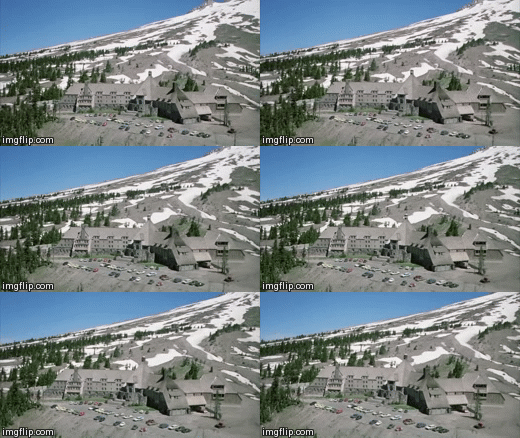
The opening sequence of this film reveals very little. The entire sequence consists of helicopter shots following a car along a mountain road. The mise en scene displays a picturesque landscape, with no apprehension for disorder. This is completely juxtaposed with the ominous music. The deep drones build an uncomfortable tone and make us relate feelings of isolation, loneliness and horror. Our expectations of a conventional horror film would be unappealing scenery, with dark lighting. This film completely subverts the typical conventions as the landscape is appealing and set during broad daylight. This tranquillity established in the mise en scene settles the audience and therefore the imminent horror will come more as a shock. Our perspective of the mood and atmosphere is highly influenced by the music. The menacing bellows distract from the beautiful landscapes and instead make us feel uneasy. The entire sequence is formed using establishing shots, these are to convey, setting, mood and atmosphere. In an unconventional way, through simply a shot of a car driving along a mountain road, this sequence does establish a slightly strange, apprehensive and uneasy mood. Through the careful composition of the shot and the placing of the car isolation is emphasised. In addition, other important production information is established through the the use of text. We understand this is a Warner Bros film as we see their trademark. This logo is held for an uncomfortable amount of time, forcing there brand into the memory of the viewers. Typography is used to create feelings of distortion. As the camera moves foreword the text moves up the screen. This makes an audience feel uncomfortable as it is not something that usually happens in a film. The effect further highlights the loneliness and isolation. The Genre of the film is not obvious through the opening sequence although from the music we suspect the thriller/horror genre.
The arrival at the old abandoned house confirms these suspicions.This is a very conventional location for a horror film. The isolation and abandonment of the old house makes the audience sense that this is where things will start to go wrong.
In summation, very little happens in this sequence. It is simply a car driving through the mountains, despite this, Stanley Kubrick (The Director) creates suspense and sets an immediate eerie and dark tone for the film.
Today's lesson was spent in the Studio with Matt and Phil. Here we were given a short introduction to the use of Camera and Tripod. The camera we used was a Sony NX5
This advanced piece of filming equipment costs around £2,500, although this may seem expensive, for a professional camera this is quite reasonable. As well as learning how fix the camera to the tripod, inserting the battery and turning on the camera, we were taught 4 main functions: focus, zoom, exposure and white balance.
Focus: this is adjusted using the first wheel on the lens of the camera. A useful technique that enables the operator to achieve sharp focus on the subject is setting up the shot then zooming in as close as possible to the subject, ensuring the focus is clear, then zooming out again.
Zoom: This is adjusted using the second wheel. This camera has a 20x zoom allowing brilliant close up shots.
Exposure: This can be adjusted using the wheel closest to the camera. Exposure refers to the amount of light in the image. If there's too much light the shot will become over exposed and very bright. if there's not enough light it will be underexposed and very dark. for extremely bright shots there are three additional ND (neutral density) filters that can be added in camera.
White balance: This is adjusted using a small switch on the side of the camera. There are too settings for different types of lighting. For example tungsten lighting will require a different white balance to natural sunlight. The aim is to make the colours look the same on camera as in real life.
Hello, my name is Ben and welcome to my Media studies AS level Blog. Here you will find an interesting and detailed documentation of my progress over the following year. Firstly, a bit about myself: I was born in Leeds, where I have lived my whole life. From an early age, I took a great interest in Performing and At the age of 13 I was accepted into the Sylvia Young Theatre School where I trained in performing arts whilst also completing my gcses After Choosing media for one of my GCSE options I grew a great passion for filmmaking. I began making short films during my spare time such as music videos, thrillers and documentaries. With my short films I managed to win 2 film competitions and I hope for my future career that I could eventually become a DOP or a cinematographer.



.jpg)


720.jpg)